Text SectionTelevision advertising has been one of the most powerful marketing forces ever created. Long before digital ads, social media, or search engines, TV commercials built brands, shaped culture, and drove massive sales at scale. Even today—despite endless new platforms—TV advertising continues to outperform most channels when it comes to attention, emotional impact, and trust.
To understand where TV advertising is going, you need to understand why it has worked so well for decades.
The Birth of TV Advertising and Its Immediate Impact
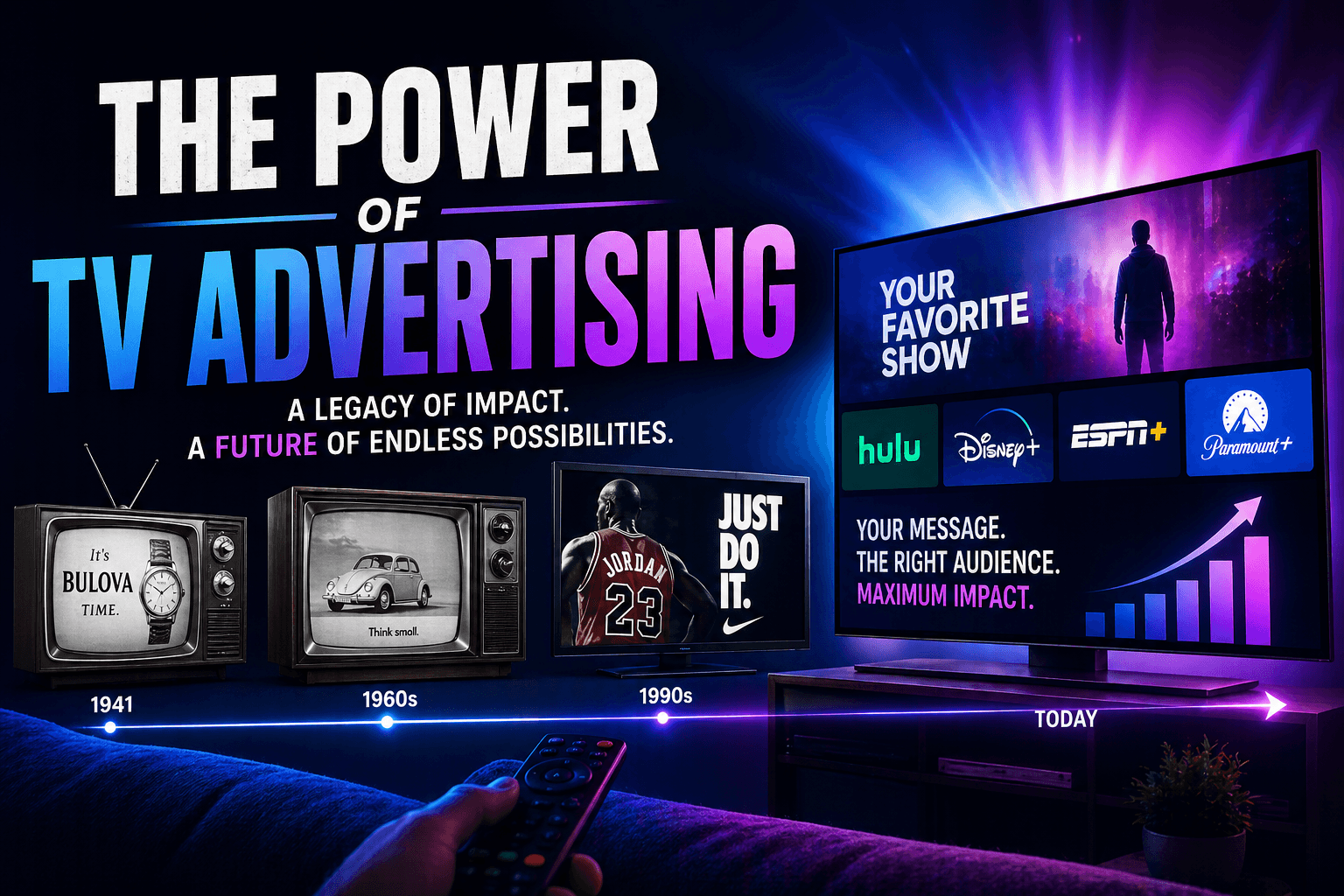
The first official television commercial aired in 1941 for Bulova Watches. It cost just $9 and reached a small audience watching a baseball game. That moment marked the beginning of a revolution.
By the 1950s and 60s, TV had become a centerpiece of American households. Brands quickly realized something powerful: they could combine sight, sound, and motion to tell persuasive stories directly inside people’s homes.
Unlike radio or print, TV advertising didn’t just inform—it demonstrated. Products came to life. Stories created emotional connections. And brands became familiar faces.
This combination of visual storytelling and repeated exposure created something incredibly valuable: trust at scale.
Why TV Advertising Works So Well
TV commercials succeed because they hit multiple psychological triggers at once.
First, attention. When someone is watching a show, they are already engaged. A well-placed commercial interrupts that engagement with a message that is hard to ignore.
Second, emotion. Video is the most powerful medium for storytelling. Music, pacing, visuals, and dialogue work together to create emotional responses that text and static images simply cannot match.
Third, memorability. Repetition on TV builds brand recall faster than almost any other channel. Seeing the same commercial multiple times embeds it into memory.
Fourth, authority. Historically, being “on TV” has been associated with legitimacy. If a brand could afford TV ads, it must be established and trustworthy. That perception still carries weight today.
Together, these factors create a marketing environment where influence compounds quickly.
The Commercials That Defined Generations
Some TV commercials didn’t just sell products—they became cultural milestones.
Apple’s 1984 commercial, directed by Ridley Scott, aired during the Super Bowl and introduced the Macintosh. It wasn’t a traditional product demo. It was a cinematic statement about rebellion and innovation. It instantly positioned Apple as a disruptive force.
Nike’s Just Do It campaigns featuring athletes like Michael Jordan turned commercials into motivational storytelling. They didn’t just sell shoes—they sold identity, ambition, and performance.
Budweiser’s “Whassup?” campaign became a cultural phenomenon, spreading far beyond television into everyday conversations.
Old Spice reinvented its entire brand with The Man Your Man Could Smell Like campaign. Fast-paced, humorous, and visually clever, it proved that a bold creative approach could completely transform perception.
Coca-Cola’s holiday commercials, especially those featuring the iconic trucks and the “Holidays Are Coming” theme, created emotional associations that return year after year.
These commercials worked because they weren’t just ads—they were experiences. They entertained, surprised, and connected.
The Evolution from Broadcast to Targeted Reach
For decades, TV advertising was dominated by major brands with large budgets. Buying airtime on national networks was expensive, and targeting was broad.
But even then, the results justified the cost. Brands were willing to invest heavily because TV delivered reach and impact that no other medium could match.
As cable expanded, targeting improved slightly with niche channels. But the real transformation came with digital technology.
The rise of streaming platforms changed everything.
Streaming TV Advertising: The Next Evolution
Today, TV advertising is no longer limited to massive budgets or broad audiences. Streaming TV Ads—also known as Connected TV (CTV) or OTT advertising—have unlocked a new level of precision and accessibility.
Now, businesses can run TV commercials on platforms like Hulu, Disney+, ESPN+, Paramount+, and others while targeting specific geographic areas, demographics, and even behavioral data.
This means a local business can run a professional TV commercial that only appears in their service area. No wasted impressions. No paying for audiences that don’t matter.
At the same time, the core strengths of TV advertising remain intact.
You still get high-quality, full-screen video.
You still capture attention in a lean-back viewing environment.
You still create emotional impact through storytelling.
But now, you also get measurable results.
Impressions, completion rates, audience targeting, and performance tracking bring TV advertising into the same data-driven world as digital marketing—without sacrificing its power.
Why Streaming TV Ads Are the Future
Streaming TV advertising combines the best of both worlds: the impact of traditional TV commercials and the precision of digital targeting.
Viewership is rapidly shifting from traditional cable to streaming platforms. Audiences are spending more time on connected TVs than ever before. And advertisers are following that attention.
What used to require massive budgets is now accessible to small and mid-sized businesses.
What used to be broad is now targeted.
What used to be difficult to measure is now trackable.
What used to be exclusive is now scalable.
This shift is not a trend—it’s a fundamental change in how advertising works.
The Takeaway
TV advertising has always been powerful because it connects, influences, and persuades at a level few other channels can reach. From the early days of broadcast to the iconic commercials that shaped culture, TV has proven its ability to drive results.
Now, with streaming TV ads and CTV platforms, that same power is more accessible, more precise, and more effective than ever before.
The brands and businesses that understand this shift—and take action—are the ones that will dominate the next era of advertising.
Because the screen may have changed… but the power of a great TV commercial hasn’t gone anywhere.


0 Comments
Join the conversation
Be the first to comment
Share your thoughts above.